Ghaziabad Enters ₹3 Crore Housing Club Amid Infra Boom
Improved connectivity via the Delhi–Meerut Expressway and upcoming infrastructure projects is pushing Ghaziabad’s real estate market into the premium segment, with homes now crossing ₹3 crore.
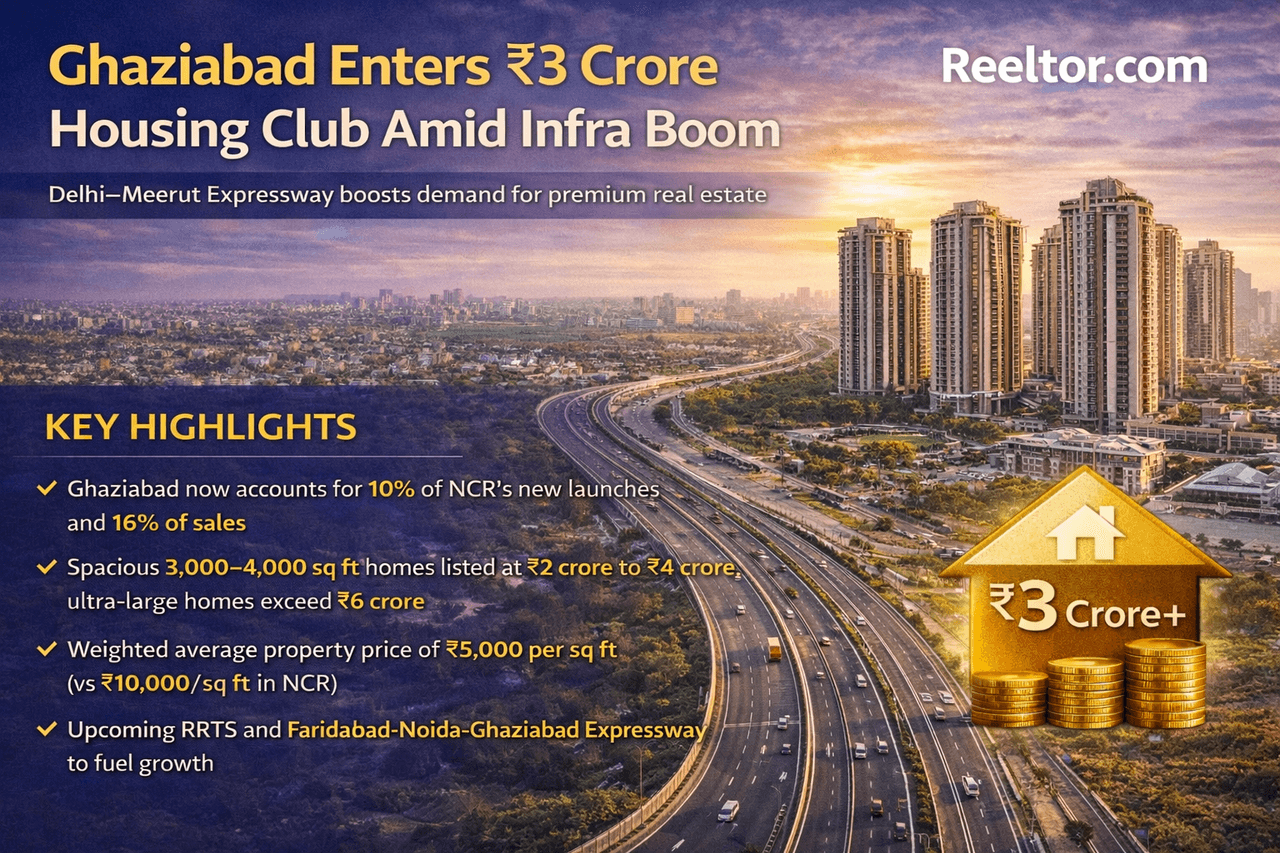
"Improved connectivity via the Delhi–Meerut Expressway and upcoming infrastructure projects is pushing Ghaziabad’s real estate market into the premium segment, with homes now crossing ₹3 crore."
Ghaziabad is witnessing a major transformation in its residential real estate landscape, with the city now entering the ₹3 crore-plus housing segment in the NCR market. Traditionally known as an affordable housing destination, Ghaziabad is gradually shifting toward premium and lifestyle-driven residential developments, largely fueled by improved connectivity and infrastructure upgrades, especially the Delhi–Meerut Expressway.
According to a report by Knight Frank India, Ghaziabad accounted for around 10% of new residential launches and 16% of total residential sales in the NCR between July and December 2025. This growing share highlights the rising interest among developers and homebuyers who are increasingly looking at the city as a viable premium housing destination rather than just an affordable alternative.
A key driver behind this shift is the development of premium residential projects along the Delhi–Meerut Expressway corridor. These projects are offering large and spacious homes ranging between 3,000 and 4,000 square feet, with features such as expansive balconies, low-density planning, and hospitality-inspired amenities. The demand for larger living spaces has been particularly strong in the post-pandemic era, as buyers prioritize privacy, comfort, and lifestyle upgrades.
Despite the emergence of premium housing, Ghaziabad still offers strong value for money when compared with other NCR markets. The weighted average property price in Ghaziabad stands at around ₹5,000 per sq ft, which remains significantly lower than nearby markets such as Gurugram, where prices average around ₹17,000 per sq ft, and Noida, where prices typically range between ₹8,000 and ₹12,000 per sq ft. Across the broader National Capital Region, the average residential price is roughly ₹10,000 per sq ft. This price advantage has made Ghaziabad an attractive option for buyers seeking larger homes at relatively lower prices.
Demand has been particularly strong in the ₹2 crore to ₹4 crore price range for spacious 3 BHK and 4 BHK homes, while ultra-large residences measuring more than 5,000 square feet are priced above ₹6 crore. Developers are responding to this demand with large-scale premium projects across key micro-markets.
Among the notable developments is “The Sunflower” by AU Real Estate, located within Aditya World City on NH-24. Spread across over 9 acres, the project offers 595 residential units, with 428 units launched in Phase I. Another prominent project is Gaur NYC Residences, developed by Gaurs Group in Wave City, where high demand has been reported for 4 BHK-plus units priced above ₹3 crore.
Industry experts believe that infrastructure development is the biggest catalyst behind Ghaziabad’s evolving housing market. The Delhi–Meerut Expressway has significantly improved connectivity, reducing travel time to Delhi to approximately 30 minutes. Additionally, upcoming infrastructure such as the Delhi–Meerut RRTS corridor, the proposed Faridabad–Noida–Ghaziabad Expressway, and proximity to Hindon Airport are expected to further enhance the city’s accessibility.
Developers also highlight that many buyers are now upgrading from markets like Noida and Greater Noida because Ghaziabad offers more space at relatively lower prices. This “space for price” advantage has become a strong selling point for premium projects along infrastructure corridors.
Looking ahead, Ghaziabad’s residential market appears poised for continued growth. As infrastructure projects progress and connectivity improves further, the city is likely to strengthen its position as an aspirational residential destination within NCR, bridging the gap between affordability and premium living.