Government Eyes InvIT Model to Boost ₹80,000 Crore Monetisation Push
The government is exploring InvITs to meet its ₹80,000 crore asset monetisation target, aiming to unlock infrastructure value despite challenging market conditions.

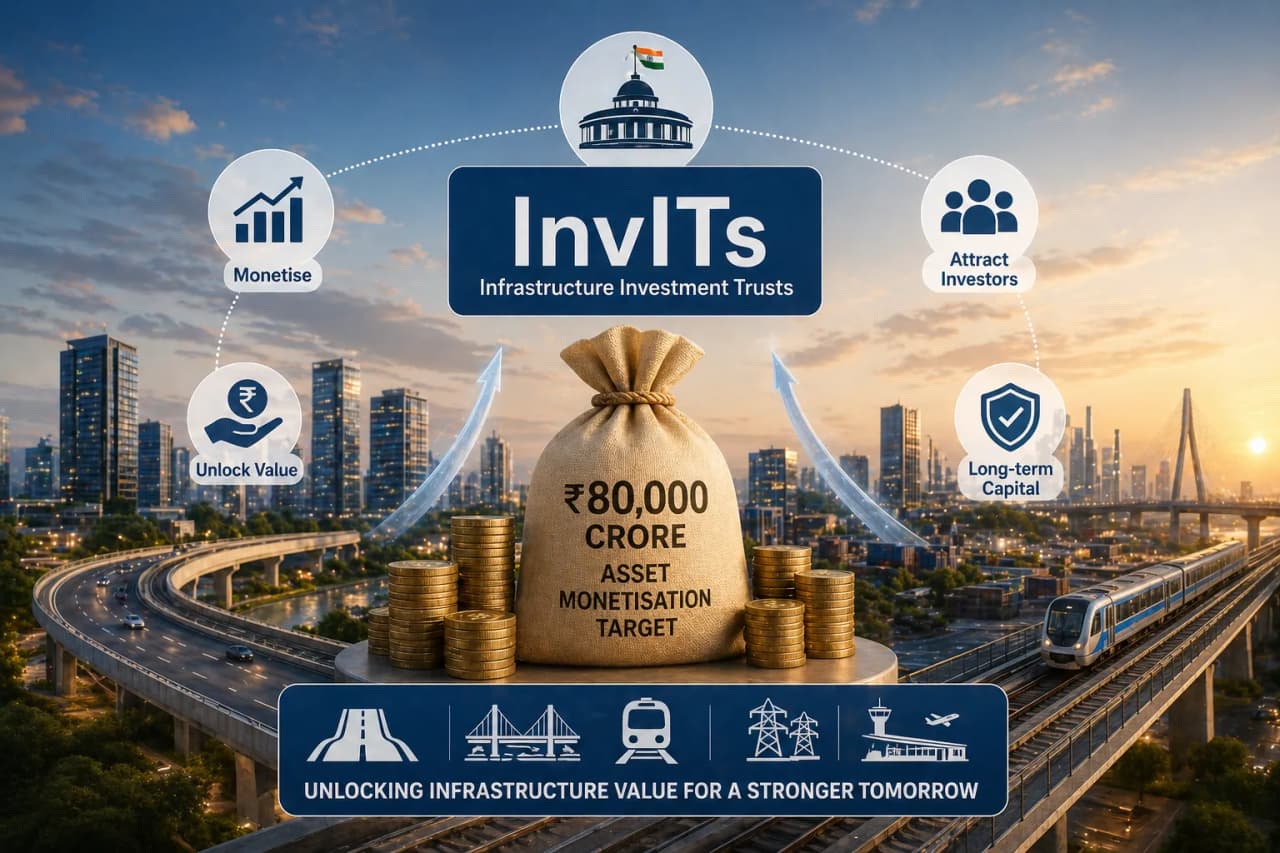
"The government is exploring InvITs to meet its ₹80,000 crore asset monetisation target, aiming to unlock infrastructure value despite challenging market conditions."
The Indian government is looking to use Infrastructure Investment Trusts (InvITs) to reach its ambitious 80,000 crore asset monetisation target. Traditional asset sales are difficult in the uncertain market andInvITsis a viable option. InvITs enable the government to make use of the value of current infrastructure assets and ensure funds are constantly available for the next stage of development.
InvITs: Definition and Relevance
Investment vehicles, commonly known as InvITs, allow pooling of funds and investment into revenue-generating infrastructure projects. Examples of these assets include power transmission lines, highways, pipelines, and telecom towers.
InvITs resemble Real Estate Investment Trusts (REITs) and offer investors a way to earn returns through regular dividends and potential appreciation. The government uses these regulated instruments which increase transparency and attractiveness for both institutional and retail investors.
InvITs give the government a more efficient, structured way of monetising operational assets, allowing it to retain a degree of control over the assets.
The 80,000 Crore Target: Background and Intent
The government's 80,000 crore target is part of a broader strategy to finance infrastructure development and avoid the fiscal strain associated with traditional government borrowing. India faces an ever-increasing need for improved road networks, railways, energy systems, and urban infrastructure, which necessitates innovative financing mechanisms.
Achieving this huge target is a challenge as the current market conditions are unfavorable for asset sales, largely due to global economic uncertainty, rising interest rates, and political instability.
However, InvITs present a solution as they can offer stable returns and a comparatively lower risk profile compared to greenfield projects, attracting a wide range of investors.
Reasons Behind Government's Choice of InvITs
There are a variety of reasons why the government is increasingly turning to InvITs:
1. Steady Cash Flow Assets
Infrastructure assets used in InvITs are normally revenue-generating, leading to steady returns that attract investors who prefer lower-risk investment options compared to newly developed or under-construction projects.
2. Participation by a Wide Array of Investors
InvITs enable both institutional investors such as pension funds, insurance companies and sovereign wealth funds, as well as retail investors, to participate in infrastructure development.
3. Reduced Fiscal Burden
The government can raise money from InvITs without increasing debt and public sector borrowings, maintaining fiscal prudence and investment in new infrastructure simultaneously.
4. Transparency and Regulatory Framework
The Securities and Exchange Board of India (SEBI) regulates InvITs, thus building investors' confidence through transparency and safeguarding their investments.
Market Hurdles
InvITs, despite their advantages, are not immune to market challenges. Global uncertainty, interest rate hikes and volatile market conditions make investors cautious about them. High interest rates can make them less attractive than other debt instruments and issues like valuation and complex regulatory procedures can slow down InvIT issuance and scalability.
The government must structure InvITs effectively to make them appealing to investors while still meeting its target for monetisation.
Infrastructure and Real Estate Impact
The increased use of InvITs is expected to positively affect infrastructure and real estate. In terms of infrastructure, it offers a sustainable method of funding without solely relying on government budgets.This should accelerate projects and help boost connectivity.
Commercial and logistics real estate sectors are expected to gain from the increased investor confidence and liquidity resulting from such vehicles. With an improvement in infrastructure, surrounding real estate is also likely to increase in value.
Investor Opportunities
InvITs provide investors with steady income, long-term growth potential, and lower risk, which can be an attractive proposition in a volatile market. They help diversify portfolios and gain exposure to large infrastructure projects. Investors should conduct due diligence and assess factors such as the quality of the underlying assets and management.
Global Trends
Globally, a variety of models based on InvITs have successfully monetised infrastructure assets and attracted private capital while reducing reliance on public funds. With growing investor knowledge and developing regulations, India is moving in the right direction, and InvITs are expected to become common in the coming years.
Future Prospects
The government's increasing use of InvITs is indicative of a shift towards more innovative, market-driven infrastructure financing approaches. This should help bridge the funding gap and boost economic growth if planned and implemented carefully. Investor confidence is growing, and a steady increase in the use of InvITs is anticipated, assisting the government in meeting its target of 80,000 crore.
Conclusion
The use of InvITs represents a wise initiative by the government. In a challenging market, these instruments are a balanced way to attract capital and provide liquidity while retaining control. Despite the obstacles present, the potential benefits of InvITs are substantial. By making the most of their value, the government can enable continuous economic development and growth.
InvITs are going to be a major trend in 2026 and beyond, allowing investors and stakeholders to be involved in India's infrastructure development and capture new opportunities.