APAC Real Estate Investments Set to Strengthen in 2026; India Emerges Among Fastest-Growing Markets
APAC real estate investments are set to grow in 2026, with India emerging as one of the fastest-growing markets driven by strong office demand and global investor interest.
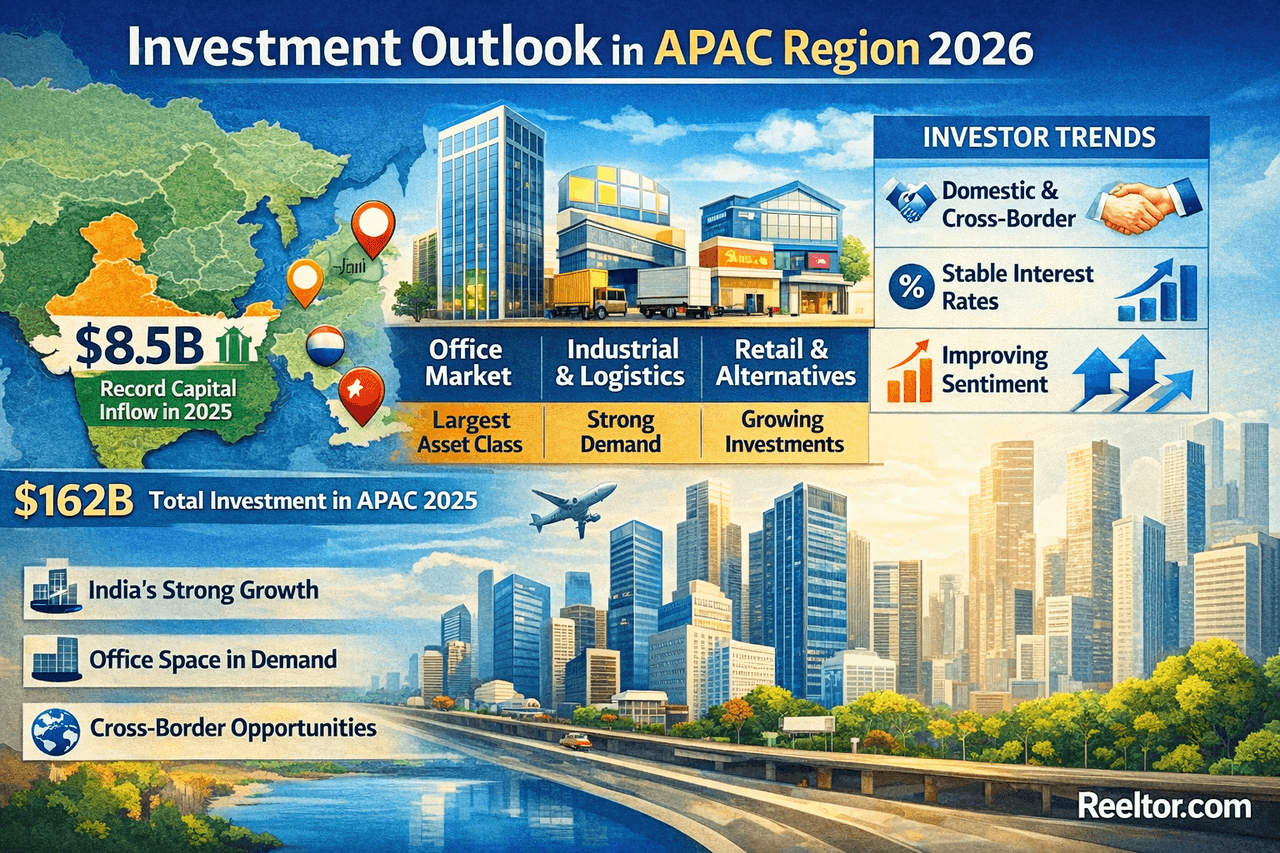
"APAC real estate investments are set to grow in 2026, with India emerging as one of the fastest-growing markets driven by strong office demand and global investor interest."
Real estate investment activity across the Asia-Pacific (APAC) region is expected to strengthen in 2026 as macroeconomic conditions gradually stabilize. According to the Colliers Asia Pacific Investment Insights Report published in March 2026, nine major markets in the region are likely to witness improved investment momentum. Factors such as stable interest rates, easing inflation concerns, and better access to financing are helping restore investor confidence. As economic stability returns, both domestic and international investors are expected to increase their exposure to real estate assets across the region.
Among the APAC markets, India has emerged as one of the fastest-growing destinations for real estate investment. In 2025, the country recorded a remarkable $8.5 billion in capital inflows into its real estate sector, marking one of the strongest performances in recent years. A significant portion of this investment was directed toward the office segment, which accounted for more than half of the total capital deployed. India’s growing business ecosystem, expanding corporate presence, and steady demand for high-quality office spaces have made the country particularly attractive to investors.
The broader APAC region also experienced steady growth in real estate investments during 2025. Total investments across the region reached approximately $162 billion, reflecting an increase of around 8 percent compared to the previous year. Investment activity was particularly strong in the second half of the year, as market sentiment improved and investors gained more clarity about economic conditions. Key markets such as South Korea, Japan, Singapore, and India recorded notable investment growth, with Singapore and India posting some of the highest year-on-year increases among the nine major markets analyzed in the report.
Different real estate asset classes have continued to attract varying levels of investor interest across the region. Office properties remain the largest and most preferred asset class for investors. The demand for high-quality commercial spaces, especially in major business hubs, continues to drive significant capital inflows into this segment. Corporations seeking modern workspaces, along with the growth of multinational companies in Asia, have strengthened the long-term outlook for office investments.
Industrial and logistics properties have also remained a strong investment category. While the growth rate in this segment has slightly moderated compared to previous years, demand remains steady due to the continued expansion of e-commerce, manufacturing, and supply chain infrastructure. Warehousing, logistics parks, and distribution centers are still considered strategic assets for investors looking to capitalize on the region’s growing consumption and trade networks.
Retail properties have seen moderate investment growth, while alternative asset classes are gradually gaining traction. Assets such as data centers, life sciences facilities, student housing, and co-living spaces are attracting increasing attention from investors who are looking to diversify their portfolios and tap into emerging sectors of the real estate market.
Investor behavior in the APAC real estate market is expected to remain largely driven by domestic capital in the near term. However, cross-border investments are gradually returning as pricing transparency improves and confidence in the global economic outlook strengthens. Institutional investors are increasingly exploring partnerships with local developers to gain access to high-quality projects and strategic locations.
India’s rising prominence in the global real estate investment landscape highlights the strength of its economic fundamentals. With a large and growing workforce, expanding corporate activity, and increasing urbanization, the demand for commercial and residential properties is expected to remain strong. As macroeconomic conditions continue to stabilize, India is likely to remain a key focus market for both regional and global investors seeking long-term growth opportunities in the APAC real estate sector.