Surge in Land Prices in Tier-2 and Tier-3 Cities: What is Driving this Trend?
Land prices in India’s Tier-2 and Tier-3 cities may rise 25–100% in 2–4 years, driven by major infrastructure projects, improved connectivity, and growing economic opportunities.
"Land prices in India’s Tier-2 and Tier-3 cities may rise 25–100% in 2–4 years, driven by major infrastructure projects, improved connectivity, and growing economic opportunities."
Land prices in India’s Tier-2 and Tier-3 cities are expected to witness significant growth over the next two to four years. Industry experts predict that land values in these emerging urban centers could increase by 25 percent to as much as 100 percent. This projected rise is largely driven by strong government investments in infrastructure, better connectivity, and the expansion of economic activity beyond major metropolitan areas. As Tier-1 cities become saturated and expensive, both investors and homebuyers are turning their attention to smaller cities that still offer relatively affordable land and high growth potential.
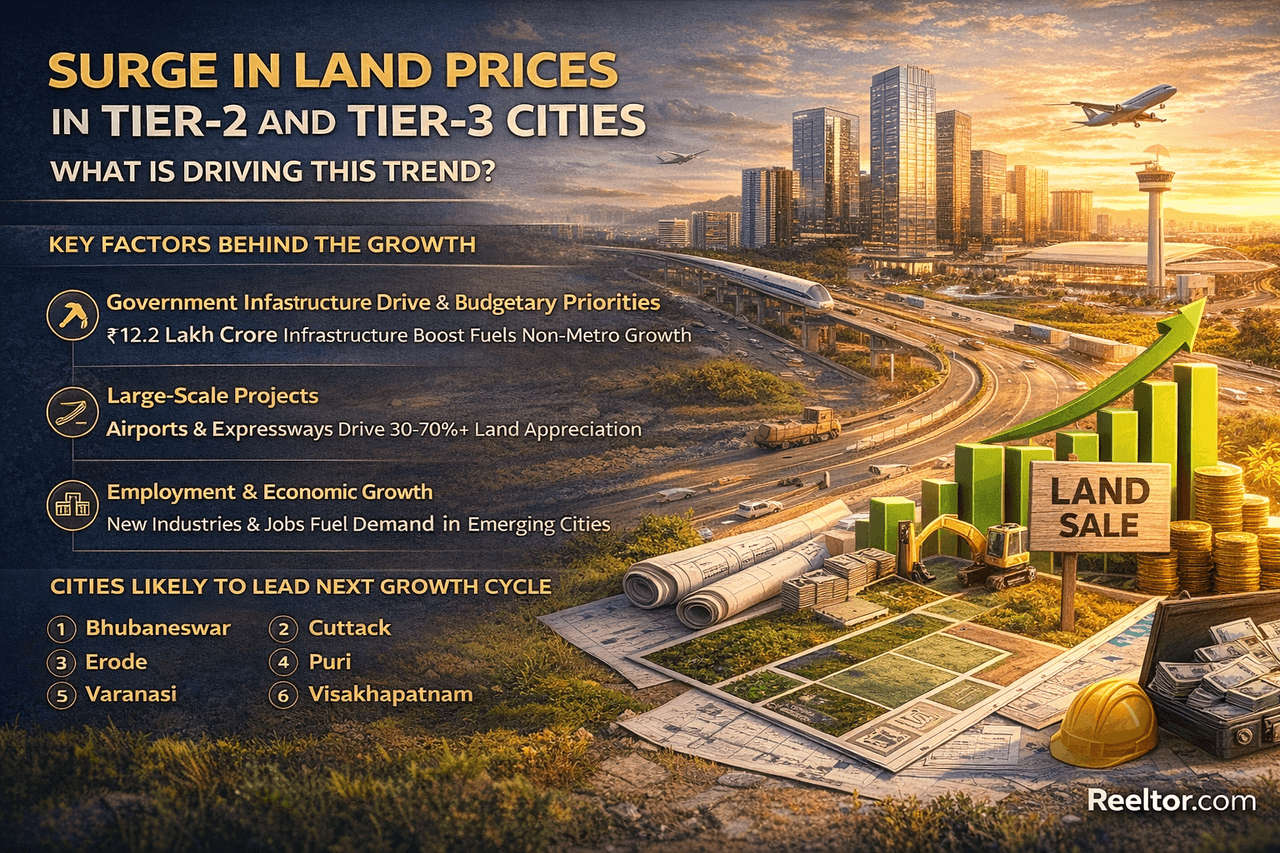
One of the biggest drivers behind this trend is the government’s strong focus on infrastructure development in non-metro regions. In the Union Budget for 2026–27, the government allocated over ₹12.2 lakh crore for infrastructure spending, highlighting its commitment to boosting connectivity and economic development in smaller cities. Projects such as industrial corridors, expressways, metro rail expansions, and new airports are being planned or developed across several regions of the country. These projects are expected to improve accessibility and create new growth hubs, which in turn will drive up demand for land and real estate.
Large-scale infrastructure projects have historically had a strong influence on land prices. When major developments such as airports, highways, or expressways are announced, land values in nearby areas often rise significantly even before construction begins. Experts estimate that land prices in the influence zones of such projects could increase by 30 percent to 70 percent from the announcement stage to completion. Residential plots located near new metro routes or transport corridors may also experience price growth of around 15 percent to 40 percent. This makes early investment in these locations particularly attractive for long-term investors.
Another important factor supporting this growth is the expansion of employment opportunities in emerging cities. Government initiatives aimed at strengthening manufacturing and technology sectors are encouraging companies to establish operations outside traditional metro areas. Programs like the Semiconductor Mission 2.0 and the expansion of industrial clusters are expected to create new jobs and boost regional economies. As employment opportunities grow, more people will move to these cities for work, increasing the demand for both residential and commercial properties.
Several Tier-2 and Tier-3 cities are expected to lead the next phase of real estate growth in India. Cities such as Bhubaneswar, Cuttack, Erode, Puri, Varanasi, and Visakhapatnam are gaining attention due to their strategic location, improving infrastructure, and availability of land for development. These cities also have relatively lower land costs compared to major metropolitan areas, making them attractive for developers and investors who want to benefit from future appreciation.
The rising demand for land in these cities is not purely speculative. There is strong interest from end users, particularly middle-income homebuyers who are looking for affordable housing options. Many first-time buyers are searching for homes priced between ₹30 lakh and ₹60 lakh, which are more readily available in Tier-2 and Tier-3 markets. At the same time, increasing incomes and lifestyle aspirations are also driving demand for premium housing projects in these cities.
For investors and homebuyers, this emerging trend offers several opportunities. Early investment in developing areas may provide significant appreciation as infrastructure projects are completed and economic activity increases. Locations close to major transport corridors or industrial hubs are expected to perform particularly well. Overall, the rapid development of smaller cities suggests that India’s next real estate growth cycle may be driven by these emerging urban markets rather than traditional metro cities.