Nearly half of India’s wealthy expect luxury housing market to moderate in FY27
56% of India’s wealthy expect the luxury housing market to moderate in FY27, though prime properties in cities like Mumbai and Delhi are still likely to attract strong demand.
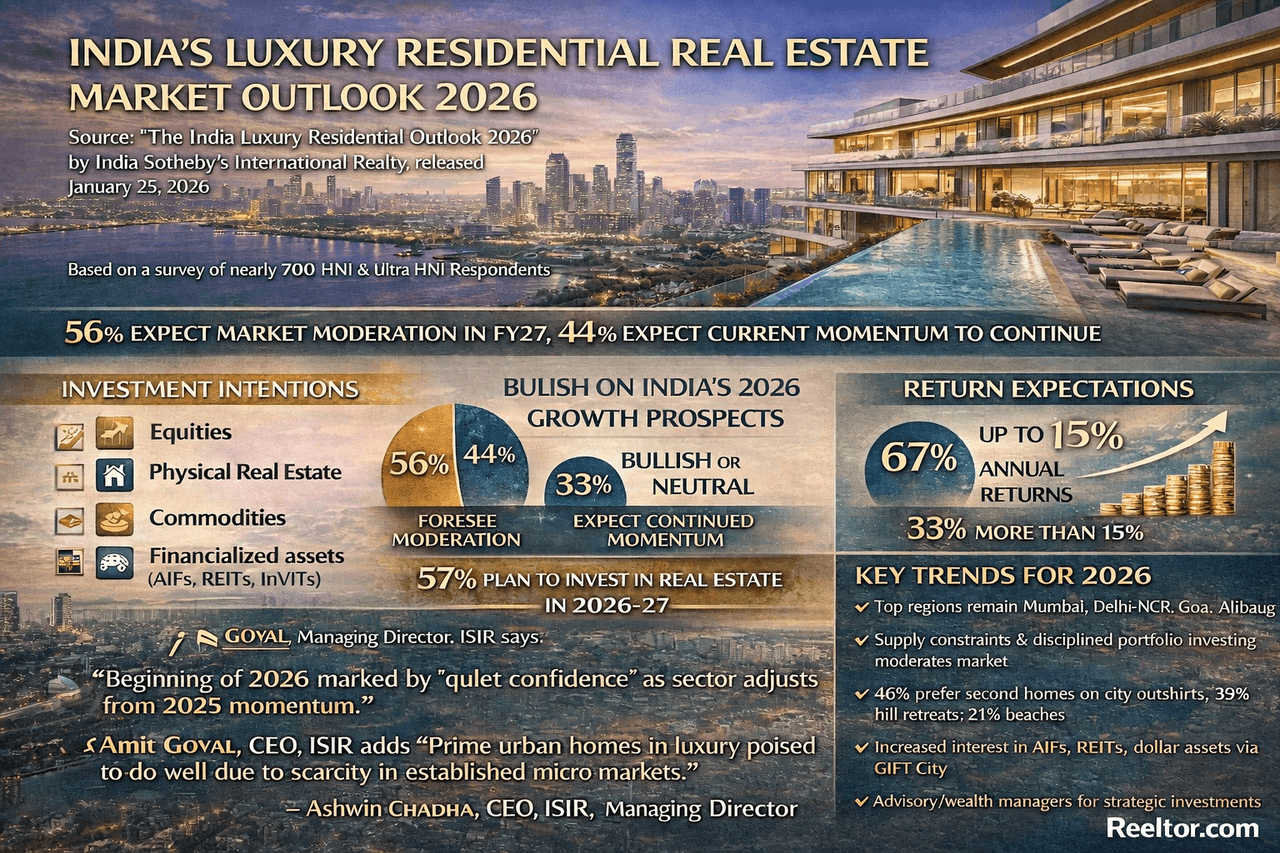
"56% of India’s wealthy expect the luxury housing market to moderate in FY27, though prime properties in cities like Mumbai and Delhi are still likely to attract strong demand."
India’s luxury residential real estate market, which witnessed an exceptional surge in 2025 with record breaking sales and landmark property deals across cities, may see a phase of moderation in the upcoming financial year. According to “The India Luxury Residential Outlook 2026” report released by India Sotheby's International Realty on January 25, 2026, nearly 56% of high net worth individuals (HNIs) and ultra-HNIs surveyed believe the luxury housing market could cool slightly in FY27. The report, which surveyed around 700 wealthy investors, suggests that while demand will remain strong, the pace of growth seen in 2025 may stabilize. The previous year saw several high profile luxury property transactions across major destinations such as Mumbai, Delhi, Goa, and Alibaug, driven largely by wealth creation from startup founders, next generation entrepreneurs, and senior professionals. Despite expectations of moderation, 44% of respondents still believe the luxury housing momentum will continue, reflecting continued confidence in premium residential real estate.
The broader economic outlook among wealthy Indians remains highly optimistic. Around 67% of respondents expressed strong confidence in India’s economic growth, even amid global economic uncertainties. Investment preferences among affluent Indians are also evolving. While equities remain the most preferred investment option at 67%, physical real estate follows closely at 64%, highlighting the continued importance of property as a long term wealth creation asset. Other investment options such as commodities, Alternative Investment Funds (AIFs), Real Estate Investment Trusts (REITs), and Infrastructure Investment Trusts (InvITs) account for 28% and 22% of investor interest respectively. Looking ahead to FY27, about 57% of respondents plan to invest in real estate, while 43% intend to pause property investments for the year. Among those planning to invest, 31% aim to purchase a primary residence, 30% are targeting investment grade real estate assets, 21% are interested in second homes, and 18% plan to invest through financial real estate vehicles.
Return expectations have also become more realistic. The survey shows that 67% of wealthy investors expect annual returns of up to 15% from real estate, while 33% continue to expect returns above that level. Experts attribute the moderation in sentiment to several factors including rising property prices in key micro markets, limited supply of high quality luxury projects, and the growing shift toward disciplined portfolio based investment strategies. Increasingly, investors are focusing on properties that offer both lifestyle benefits and stable rental yields. The role of professional advisory services is also expanding, with around 20% of respondents relying on expert advice for property investments. Additionally, 16% of investors have family members living overseas, which has sparked growing interest in international diversification and dollar denominated assets through financial hubs such as GIFT City.
Second homes and holiday homes continue to remain popular among affluent buyers, although they are increasingly viewed as lifestyle assets rather than purely financial investments. Around 75% of respondents reported purchasing a second home in the past year, though demand has slightly softened due to rising property prices and supply constraints. Preferred locations for second homes include farmhouses on city outskirts (46%), hill or mountain destinations (33%), beach locations (21%), and spiritual destinations (7%). Many buyers prefer properties located within a four hour travel radius from major cities, allowing convenient weekend access.
Industry leaders believe that while the market may experience a period of stability, prime luxury properties will continue to perform strongly. According to Amit Goyal, Managing Director of India Sotheby's International Realty, the start of 2026 reflects “quiet confidence” as the sector adjusts after the strong momentum of 2025. He also noted that the composition of buyers has changed significantly, with new wealth creators emerging from stock markets, startup ecosystems, and IPO driven success stories. Similarly, Ashwin Chadha, CEO of the firm, believes that although buyers may adopt a more cautious approach in FY27, prime urban luxury homes will continue to command premium pricing due to their inherent scarcity. Established luxury micro markets such as South Mumbai, Lutyens' Delhi, and select premium locations across the National Capital Region are expected to remain highly sought after.
Overall, the report suggests that India’s luxury housing sector is gradually moving from the post pandemic surge toward a more mature and stable growth phase. While the rapid growth of the past few years may slow slightly, strong economic fundamentals, wealth creation, and limited supply in prime locations are likely to ensure that the luxury real estate market continues to perform well in the coming years.