International Women’s Day 2026: Women account for just 11% of home loan market, lead only in Gurugram and Noida
A 2025 study shows women hold just 11% of home loans in India, with higher borrowing only in Gurugram and Noida, highlighting a major gender gap in housing finance.
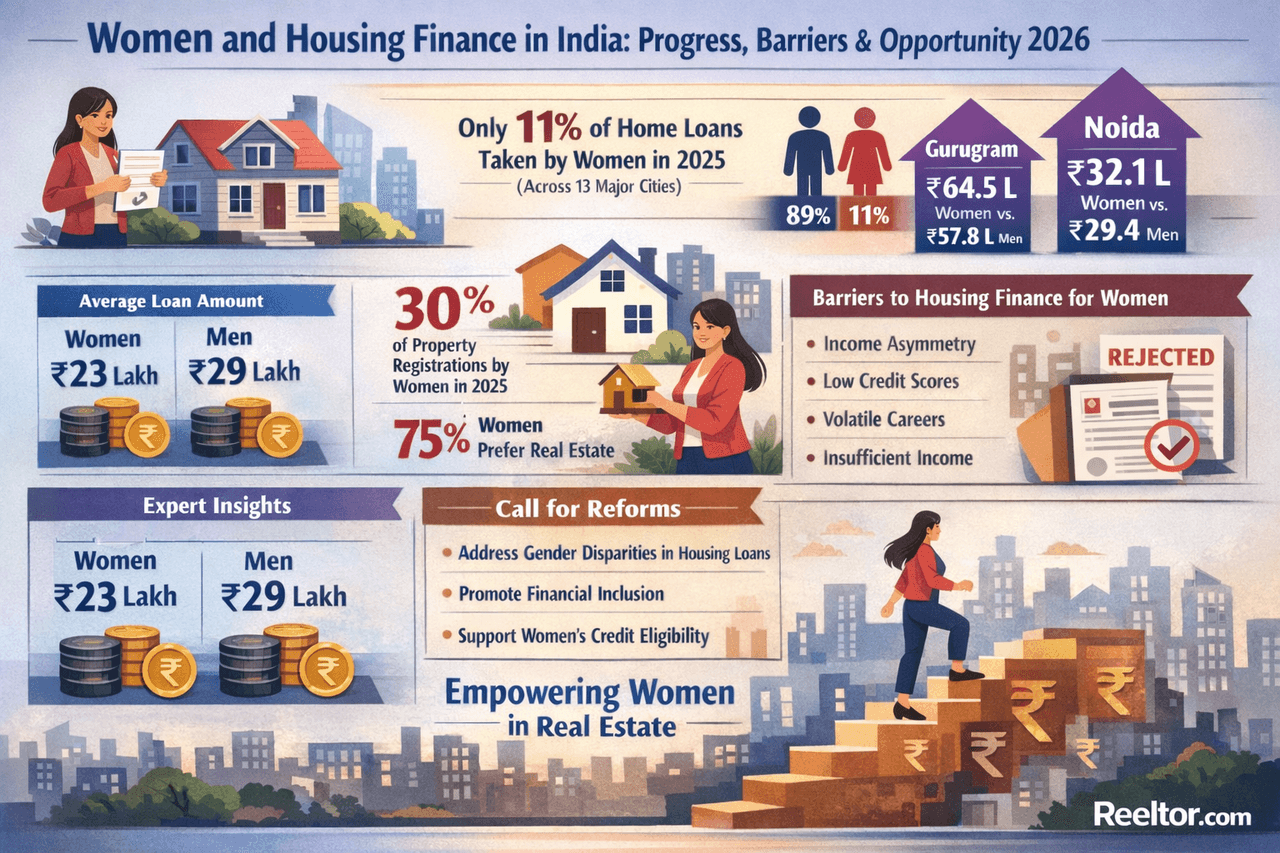
"A 2025 study shows women hold just 11% of home loans in India, with higher borrowing only in Gurugram and Noida, highlighting a major gender gap in housing finance."
A report released ahead of International Women’s Day 2026 highlights a significant gender disparity in India’s housing finance sector, revealing that women account for only 11% of the home loan market despite their growing economic participation and interest in property ownership. The findings come from a study conducted by Urban Money, the fintech mortgage arm of Square Yards, which analyzed housing loan data for 2025 across 13 major Indian cities. According to the research, women represented only a small fraction of the total 56,523 home loans sanctioned during the year, demonstrating a considerable gap in access to housing finance between men and women. The cities covered in the study include Ahmedabad, Bengaluru, Chennai, Delhi, Faridabad, Ghaziabad, Greater Noida, Gurugram, Hyderabad, Mumbai, Noida, Pune, and Thane. The data also shows that women tend to take smaller home loans on average compared to men. The average loan ticket size for women stood at ₹23 lakh, while men borrowed around ₹29 lakh. Interestingly, women outperformed men in terms of average loan ticket size in only two cities—Gurugram and Noida—both located in the National Capital Region. In Gurugram, women borrowed an average of ₹64.5 lakh compared to ₹57.8 lakh for men, while in Noida women borrowed ₹32.1 lakh compared to ₹29.4 lakh for men. These exceptions are attributed largely to joint property ownership structures, tax advantages, and stamp duty optimization practices that encourage registering property in women’s names. At the other end of the spectrum, women in Chennai recorded the lowest average home loan ticket size at ₹12.7 lakh, reflecting significant regional differences in borrowing patterns. The study also highlighted broader socio-economic trends. Although women represent nearly half of India’s population and were responsible for about 30% of residential property registrations in 2025, their participation in housing finance remains limited. Industry surveys indicate that nearly 75% of women prefer real estate as an investment asset, yet this interest has not translated proportionately into access to housing loans. Experts attribute this gap to multiple structural barriers, including income asymmetry, nonlinear career paths, unstable work histories, insufficient income levels, and limited or weak credit histories. According to Kanika Gupta Shori, COO and Co-Founder of Square Yards, India has made significant progress in women’s socio-economic participation, but this advancement has not yet fully translated into improved access to housing finance and property ownership. She emphasized that women represent a largely untapped segment in the housing finance market and that improving their access to credit is essential for financial inclusion and economic empowerment. Similarly, Amit Prakash Singh, Co-Founder and Chief Business Officer of Urban Money, stated that the opportunity lies not only in offering incentives but also in designing systems that improve women’s credit eligibility and independent financial participation. The report, titled “Women and Housing Finance in India: Progress, Barriers and the Opportunity,” ultimately underscores the need for structural reforms that can bridge the gender gap in housing finance. Expanding women’s access to home loans could play a crucial role in strengthening financial inclusion, increasing property ownership, and supporting long-term economic empowerment for women across India.